
|
|

 |
The Complete Jack Johnson Sessions
by Marshall Bowden
The Complete Jack Johnson Sessions represents a stunning crossroads where boxing, the Black Power movement, the development of rock music as an expression of vast changes in American society, the electronic amplification of jazz, and Miles Davis all came together. That the music heard on this newly-released 5 CD set was boiled down to a mere hour's worth of a soundtrack album, with snippets turning up on Live-Evil and Get Up With It, is amazing. Listening to the music here, most of which has never been released previously, is like finding out something new about someone you thought you knew well.
That Miles Davis should have been drawn to the figure of Jack Johnson is no surprise. Johnson, the first black heavyweight champion and star black sports figure, fought during the early 1900s, at a time when racism was de rigeur and jazz music was only beginning to develop. Johnson liked the high life, enjoyed fast cars and liked women, particularly white women. While Miles preferred black women, he certainly appreciated beautiful ones, had sartorial style, like his home to be well appointed and modern, and also adored fast sports cars. Much has been made of the fact that Miles was born into a middle class background (his father was a successful dentist) but that only seems to have made the racism that he encountered that much more unpalatable, and Davis did encounter his share. The well known incident that occurred in front of Birdland, when Miles was hassled by police for standing outside the club and took a blow to the head from a white detective, seems to have set him firmly on the path of not taking any crap from anyone, an attitude that was certainly in line with that of Jack Johnson as well as boxers that Davis had seen during his lifetime.
Davis was in a highly productive and inspired mode at this time, a mode that had started with the recording of In a Silent Way and continued through Bitches Brew. He also made a big switch with his live bands, moving from the repertoire he had been playing, which was comprised largely of music he'd created with his second great quintet between 1963 and 1967, to the new material he was recording. His live bands changed personnel more frequently, with Chick Corea, Keith Jarrett, Michael Henderson, Jack DeJohnette, Dave Holland, Steve Grossman, Gary Bartz, and others moving into and out of the band at various times. "I was seeing it all as a process of recording all this music" said Davis, "just getting it all down while it was flowing out of my head." In A Silent Way had been a bellwether, signalling that changes were afoot, not only in Davis' performances of his new music, but in the very methods that were used to create that music in the first place. Both In A Silent Way and Bitches Brew were recorded in small sections, with Davis directing the musicians and allowing them to play freely without worrying about what the final mix for release would be like-in fact, many times the musicians had no idea what would or would not be released. Davis and producer Teo Macero then constructed the final tracks from these performances. On In A Silent Way they took shapeless but incredible segments of music and spliced the performance together to create a piece that had form and structure. The technique was used again on the Bitches Brew album, both on Joe Zawinul's "Pharoah's Dance" and on the title track.
|
|

The album A Tribute to Jack Johnson, the soundtrack to the William Clayton-directed film of the same name, was probably the end of the high point of the Davis/Macero edited recordings cycle. The same approach was applied to live recordings such as At Fillmore and to source recordings done at Washington D.C.'s Cellar Door club, resulting in the album Live-Evil. The results were decidedly mixed, with the continuity and structure of the live performances missing. But on Jack Johnson, the producer was able to take what was essentially a studio jam and turn it into the best melding of jazz, funk, and rock music of all time. Considering the furore that Bitches Brew had caused, it is amazing today to consider that Jack Johnson sank without a trace when it was released more than a year after it was recorded, in the summer of 1971. By that time, Miles had rolled his electric band out to live audiences, performing at Fillmore East and West as well as at other important venues, generally as an opening act for some of the most successful rock bands of the day. At the end of August 1970 Davis performed at the Isle of Wight Festival, one of the major rock festivals held in the wake of the successful fests at Monterey and Woodstock. The sessions that are represented on this box set, all recorded between February and June of 1970, were Davis' last recording sessions until 1972, when he recorded the sessions for his highly controversial On the Corner album. Consider this, though: by the time the public heard the recording Bitches Brew (released in April 1970) Davis was already unleashing a much more heavy electric sound on audiences at the Fillmore West (released unedited as the Black Beauty album). And, three days before this performance, he had recorded most of the source material that would be edited into the Jack Johnson album-material that was based much more on straightforward rock and funk concepts with fewer free jazz leanings and which would represent probably his most accessible music until his return to the scene in 1981 after a self-imposed five year silence. In other words, by the time the record-buying public heard Bitches Brew, Davis had already moved another several steps ahead. No wonder the public was unable to keep up with him during this tumultuous period-the man simply had too much music, and too many ideas spilling out of his head for the slow-moving recording industry to keep up with.
|
|

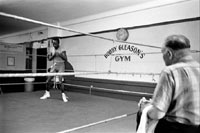

Miles was always interested in boxing, and as a youngster he used to love to box and to swim. He listened to Joe Louis bouts on the radio, and he noted in his autobiography how the entire neighborhood would go crazy in celebration when Louis knocked out his opponent. Later, in 1952, he approached trainer Bobby McQuillen about taking him on as a boxing student. McQuillen told Davis he wouldn't work with an addict, and that he should kick his habit first. Inspired in part by the disciplined nature of fighter Sugar Ray Robinson, Miles returned to St. Louis where, with the help of his father, he managed to kick the heroin habit that had temporarily derailed his career. In his essay on Mike Tyson, Gerald Early says of Robinson: "Robinson was the first and only boxer who ever gave the impression of being sophisticated, a cosmopolite-and yet he was unmistakably a black man, perfectly at ease with himself and his blackness." The same might easily be said of Miles Davis, who made understatement and exactitude highly important elements in the birth and maintenance of his cool persona. "The reason I'm talking so much about Sugar Ray" Miles tells us, "is because in 1954 he was the most important thing in my life besides music. I found myself even acting like him, you know, everything. Even taking on his arrogant attitude. Ray was cold and he was the best and he was everything I wanted to be in 1954. I had been disciplined when I first came to New York. All I had to do was go back to the way I had been before I got trapped in all that bullshit dope scene."
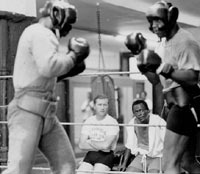
By '54 Miles had quit heroin, was back on top with his Miles Davis Allstars recording Walkin', and was training with McQuillen at Gleason's Gym in midtown or, sometimes, at Silverman's Gym in Harlem. He was still working out with McQuillen (now going by the Muslim name of Robert Allah) in 1970 when he recorded these sessions. In fact, Davis may have been in the best physical shape of his life around this time. He was working out consistently, boxing with McQuillen, eating well, and working to stay off drugs. The clear-mindedness, physical exhilaration, and stamina show on Bitches Brew as well as on the live recordings of Miles from 1969 and 1970, and they show clearly on these sessions as well. Miles was playing well, his breath control was excellent, and his trumpet playing had a new, more aggressive attack that fit well with the electronics his bands were using.
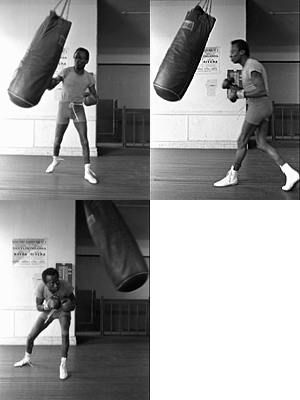 |
"I had that boxer's movement in mind" says Davis of the music on Jack Johnson, "that shuffling movement like boxers use. They're almost like dance steps, or like the sound of a train…That train image was in my head when I thought about a great boxer like Joe Louis or Jack Johnson. When you think of a big heavyweight coming at you it's like a train." Indeed the first of the two pieces found on the original Jack Johnson album, "Right Off" is a shuffle, the kind of bluesy, swinging beat that Count Basie had championed in Kansas City. But in Paul Tingen's book Miles Beyond, John McLaughlin remembers that the piece started off as a spontaneous jam session that was recorded. In any event, Miles is referring in this quote to the music that actually ended up on the Jack Johnson album. That music was mostly put down during the session held at Columbia Studio B on April 7, 1970. Reference has been made to a November 11, 1970 session (which was supposed to have yielded the track "Right Off"), but this is inaccurate. From the music recorded on this date plus an unaccompanied trumpet solo by Miles that he had recorded at the end of a session late in 1969, producer Teo Macero constructed the 26 minute 52 second final version of "Right Off." "Yesternow" utilizes much of the April 7 material as well, but Macero also interjects segments from several different takes of the piece "Willie Nelson," the unaccompanied Davis trumpet solo, an orchestral interlude, and a segment of "Shhh/Peaceful" from the February 18, 1969 session that yielded In A Silent Way.
|
|

The final versions released as Jack Johnson are heard here as the last tracks on the final, fifth CD. But there is a tremendous amount of music to hear before the listener gets to this point, the overwhelming majority of it never officially released before. Just as with Columbia's previous box sets The Complete In A Silent Way Sessions and The Complete Bitches Brew Sessions, tying all of the music here to the single studio album that Davis released in the period is a bit misleading. Much of the music recorded here was never intended for the Jack Johnson project, and a little of it turned up elsewhere, most notably on Live-Evil, Big Fun, Get Up With It, and Directions. However, the breakup of Miles' studio work into segments is right, just as it was right to include the two pieces featuring Dave Holland and Chick Corea on The Complete In a Silent Way Sessions rather than on the preceeding set of music by the second great quintet, even though those tracks appeared on Filles de Kilimanjaro, the quintet's final recording.
Nonetheless, Miles definitely had boxing on his mind, as pieces recorded at several of the sessions both before and after those that resulted in Jack Johnson are named after fighters: "Johnny Bratton," "Archie Moore," "Duran," "Sugar Ray," and "Ali." He also had in mind the kind of Friday night juke joint where musicians were likely to jam on blues changes and the supercharged funk of James Brown. The Complete Jack Johnson Sessions reveal the most straightforward, funky music of Davis' entire career. One of the questions that has often been asked is, if Miles wanted to create funky dance music why didn't he just do it? Why the dense textures, the overlaid tabla rhythms and other trappings that have made his so-called "funk" music seem more like anti-funk? Why couldn't Miles create something that went straight for the booty, as his former keyboard player Herbie Hancock did on his Headhunters album? The evidence here points to Miles doing exactly that, but of course, he was doing like Miles. Another interesting point is that Miles was very sold on featuring the electric guitar in his band. Since using John McLaughlin on the Silent Way and Bitches Brew sessions, Miles seemed to hear guitar in all of his music. Nonetheless, his band during the period covered on The Complete Jack Johnson Sessions had no guitar. In fact, he still had no guitar at the end of the year when his group recorded their stand at The Cellar Door. Miles invited John to come down and play with the group for one night, and those performances ended up being the ones used for Live-Evil. There's quite a bit of debate over whether those recordings were representative of the band, with Keith Jarrett going on record as saying that they most definitely were not. When Hancock decided to record a funk album with Headhunters, his band included no guitar at all, only Hancock's keyboard setup of Fender Rhodes, Clavinet, and a couple of ARP synthesizers as well as some effects. As the seventies wore on the electric keyboard and the electric bass became the calling cards of the new funk sound, with electric guitar often relegated to performing rhythm duties. Miles went against this, abandoning keyboards (or lessening their importance) in favor of guitar, then later adding a second guitar. This made his version of funk sound completely different and out of tune with the prevailing concept of funk in most listeners' minds.
|
|


Another new element in the band that recorded the material that mostly became the Jack Johnson album in April 1970 was bassist Michael Henderson. Henderson had played with Detroit soul acts like the Fantastic Four, Detroit Emeralds, and Billy Preston since turning thirteen. He later toured with Aretha Franklin and Stevie Wonder before Miles brought him into his band. Henderson was the first musician that Miles had hired who did not have a jazz background and who had never played acoustic bass; he formed the basis of Miles' rhythm sections for the remainder of the 1970s, becoming a fixture with Davis until his semi-retirement began in 1976. When Miles reconvened his band in the studio to record the sessions for On the Corner in 1972 Henderson was the only former member of his band who was left. Clearly Henderson brought something to the group that the other jazz bassists hadn't quite been able to. That something was his ability to create a circular, funky riff and to stick with that no matter what else was going on. The key element here is that Davis was creating funky music, black music. Listen to the interaction between bassist Gene Perla and drummer Billy Cobham on the two takes of "Ali" presented here, or Jack DeJohnette's drum work on the first six tracks of the set, a number that became known as "Willie Nelson." You hear the stuttering funk drumming that comes up from the New Orleans second line channeled right into the stop/start speeded up James Brown sound. Yet at the time all anyone could hear was the electric guitar of John McLaughlin, and the music was labeled as rock. Miles believed that funk and the raunchy electric guitar sound went together. After all, the guitar sound was inspired by Jimi Hendrix, and Miles recognized Hendrix as a blues-based black musician even though Hendrix' audience was overwhelmingly white and overwhelmingly rock based. Both Sly and the Family Stone and George Clinton's Parliament were incorporating rock guitar into their funk jams, but again it just didn't seem to be noticed. Not until the arrival of Prince in the 1980s did another artist so successfully unite the rhythms of funk with the nasty, distorted guitar of hard rock. Later in the same decade, hip-hop began to incorporate a hard rock guitar sound, and soon it became an accepted thing.
|
|


Of course, Miles was also creating some music that fell into the rock area. In fact, reissue producer Bob Belden has said "This is the album that is going to get Miles into the Rock & Roll Hall of Fame." "Go Ahead John" pretty much gets into a pure rock groove, even though it starts out with a lyrical Miles trumpet statement and moves through a few different styles. We can now enjoy the jam, including lengthy solos by Miles, Steve Grossman, and, of course, John McLaughlin. When the track was originally released in 1974 as part of the Big Fun double album it was cobbled together from various parts of the takes heard here (five in all) and mixed with an automatic switching device that moved McLaughlin's guitar sound back and forth between channels in what now comes across as a fairly amateur dub technique. Unfortunately, it was excruciating and just plain uninteresting to listen to. Here, it becomes much more interesting, even though there is no single track that truly constitutes a whole piece of music. It doesn't matter though-these sessions, done March 3, 1970, were definitely some kind of run through for what would become the Jack Johnson soundtrack, sharing a particular affinity with "Right Off." Another track with a rock bent is "Honky Tonk," two versions of which are heard here. Part of the first (labeled Take 2) was used as the final track that appeared on the Get Up With It album. In addition, the introduction was fused to a live Cellar Door performance as an intro to the track "Sivad" from Live-Evil. The track is arresting as it often threatens to settle into a clichéd blues rock groove, but never does for very long, the rhythm consistently being broken up by Keith Jarrett and Billy Cobham. The May 19 session from which "Honky Tonk" comes was Jarrett's first with the Davis group, and he appears on many of the set's remaining sessions as well, but he may well have been figuring out his role for much of this, because he is never as strong an element in the music as one might have expected. In all likelihood we'll have to wait for the complete Cellar Door performances to be released to really gauge Jarrett's impact, because that is when the group supposedly began to really gel.
Things get a little less interesting over the last two discs in the set, which feature the last studio sessions that Miles & Company would have for nearly two years. The multiple versions of "Nem Um Talvez" that Davis recorded with Hermeto Pascoal are interesting primarily because they show that more interesting versions of this existed than were used on Live-Evil, but they are not so interesting as to completely alter one's perception of the piece. Other pieces that appeared in some version on Live-Evil, including "Little Church" and "Selim" don't benefit from their inclusion here because there's nothing new to add and the original tracks weren't as full of ideas as some of the other pieces. The lengthy open jam "The Mask" that is featured on Disc Five was played live a few times, but this is the first time the studio versions have been heard. Unfortunately, there isn't a lot of interest here, even for free jazz fans. The disc, and the set, end with the original album-length versions of "Right Off" and "Yesternow" .
 |
 |
That's not to say that the music on these last couple of discs isn't interesting at all, it's just questionable how often any listener will want to return to them. The same cannot be said of the first three discs in the set-they are completely arresting, artistically stunning, and unlike quite anything else that had been heard up until their recording.
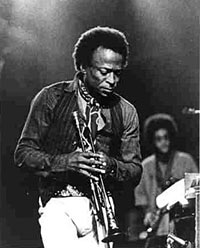
The remaining material, all named after boxers (with the exception of "Willie Nelson" which wasn't titled until it was pulled from the vaults in the early '80s for release) are Miles's most straightforward funk/blues/rock statements. "Johnny Bratton" is a slow burn urban groove featuring wide-open chords from McLaughlin, Dave Holland's electric bass groove, and Jack DeJohnette's driving drumming. On the subsequent two takes (there are three included) it begins to percolate more, with McLaughlin playing more of a rhythm guitar role. "Archie Moore," recorded only once, is a slow blues by the same lineup that recorded "Go Ahead John." Miles apparently thought he had a hit record with "Duran," which features an incredibly hooky bass line played by Holland and Billy Cobham's excellent drumming. While it is closer to what we normally think of as fusion than most of Davis's other work, it lacks any interesting melodic structure that might have made it successful with rock listeners. "Sugar Ray," a tribute to Miles's role model, presages the kind of stop/start funk groove that would be utilized on On The Corner and subsequent Davis work, although here it is presented in a much more open, less dense manner. Toward the end drummer Lenny White breaks into a stuttering sixteenth note beat that will sound familiar to anyone who listens to today's electronic Drum 'N' Bass music. "Ali," recorded at the same session that yielded "Honky Tonk" is structured around a killer bass riff, with Miles darting in and out making brash pronouncements just as Ali himself did. On all of these tracks Davis plays with an aggressive, in your face style that was somewhat new for him, and a definite change for listeners more familiar with the introverted sound of his muted trumpet and lyrical playing on recordings such as "My Funny Valentine" and "Someday My Prince Will Come."
 |
This was clearly a very fertile period for Miles Davis and his musicians in the studio, but like all things it came to an end. Davis began to concentrate on his live band, seeking to turn the music he had been working on in the studio into an exciting listening experience for a live audience. It seems as though Miles would work out the new sound or ideas he had in the studio and then slowly introduce the new repertoire into his live sets until the music he was playing live was in line with what he was releasing on record. Several live recordings were done during this period as well, and a wealth of material was recorded that was never released. Davis would only make two more real statements via studio work during the remainder of the decade: On The Corner and Get Up With It. While On the Corner would advance Davis's concept of black urban funk, it didn't connect with either a jazz or rock audience very well and remains Davis's most controversial release. Get Up With It contained much of interest, but it was ultimately a hodgepodge of styles from sessions held between 1970 and 1974. The music that Miles created during 1970 was mostly overshadowed by the release of Bitches Brew, and most of the work that came after (including the Fillmore East and West albums, Live-Evil, and Jack Johnson) have long been seen as disappointing followup work to that major release. With the release of these long-unheard recordings (and the upcoming release of a Cellar Door box set) it can now be stated that nothing could be further from the truth. Miles had simply moved on by the time the record-buying public caught up to where he was at, a not infrequent occurrence in the career of this one-of-a-kind jazz pioneer. The Complete Jack Johnson Sessions scores a decisive knockout in five rounds.
 |
"If you see a good Boxer its like a form of art…"
Miles Davis